
New network data reveals how Starlink is reshaping internet connectivity, particularly in Africa, where satellite broadband is becoming an increasingly important part of digital infrastructure.
As traditional fiber-optic and mobile networks struggle to reach remote and underserved regions, low Earth orbit (LEO) satellite technology is transforming global internet access.
Operated by SpaceX, Starlink has established itself as the world's leading satellite broadband network, supported by an expanding satellite constellation and ground infrastructure.
But beyond official coverage maps, another indicator offers valuable insights into Starlink's global expansion: the allocation and utilization of IP addresses.
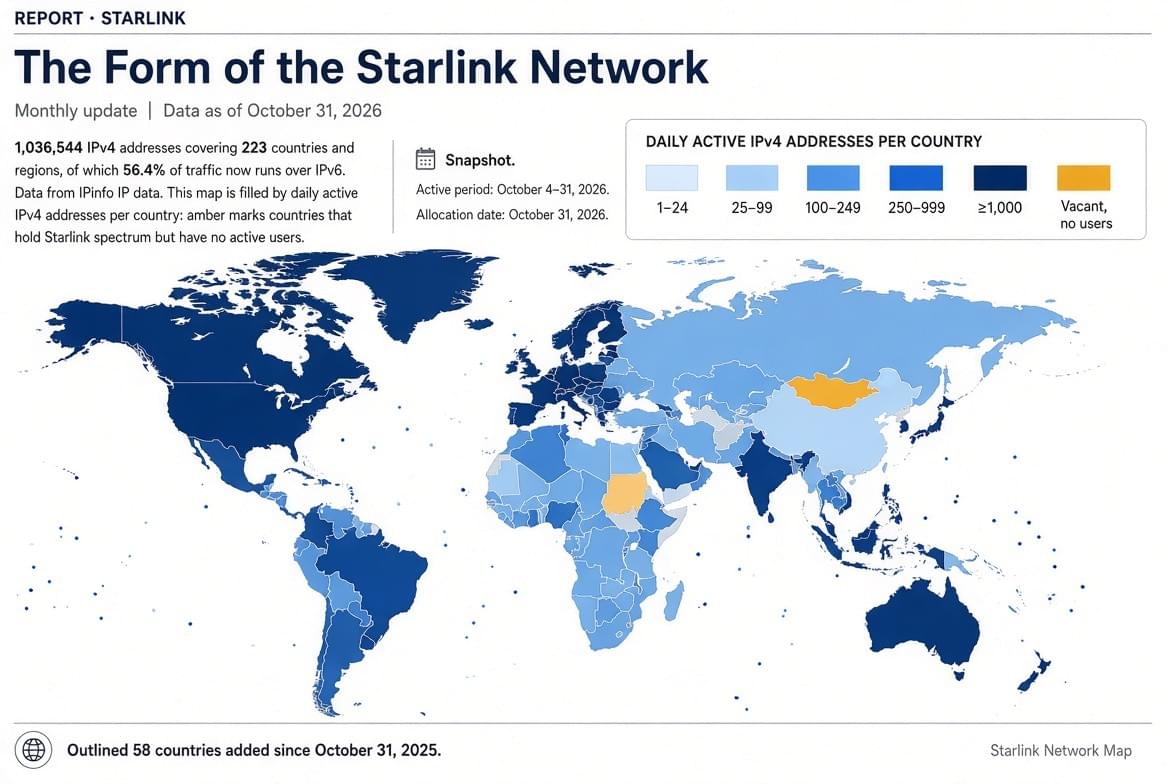
According to network monitoring data attributed to IPin, as of October 31, 2026, Starlink had allocated IP address resources to 223 countries and territories, significantly exceeding the more than 160 markets where its services were commercially available.
This difference highlights an important aspect of Starlink's strategy: network infrastructure and IP resources can be deployed well before a market officially opens.
1. Starlink's IPv4 Resources Nearly Doubled in One Year
IPv4 addresses remain valuable assets in the global internet infrastructure.
With the available IPv4 address space largely exhausted, network operators increasingly rely on secondary markets to acquire additional resources.
By October 31, 2026, SpaceX's four Starlink-related networks collectively held approximately 1.04 million IPv4 addresses, compared with 531,200 a year earlier.
This represents an increase of approximately 95%, with the total surpassing one million addresses on October 8.
At an estimated market value of $20 per address, Starlink's IPv4 resources would be worth roughly $20 million.
However, the number of allocated IP addresses does not necessarily reflect actual service adoption.
In India, for example, Starlink had allocated 17,408 IPv4 addresses, yet only around seven were active on an average day during October 4–31, representing an utilization rate of just 0.04%.
Regulatory delays and outstanding approvals appear to be major factors behind this limited activity.
Ukraine presents another interesting case. Despite an allocation of 29,696 IPv4 addresses, only approximately 1,161 were active daily during the monitoring period, equivalent to around 4%.
By contrast, several emerging markets demonstrated much higher utilization:
- Venezuela: approximately 45%
- Niger: approximately 44%
- Nigeria: approximately 41%
These differences illustrate how regulatory environments, local demand and commercial readiness influence the actual adoption of satellite broadband.
2. Starlink Is Becoming a Major Internet Provider in Parts of Africa
Perhaps the most striking finding comes from Africa, where Starlink is increasingly becoming an important connectivity provider rather than simply a backup solution.
According to IPin's CDN request monitoring for October 19–25, 2026, Starlink accounted for a substantial share of observed internet requests in several countries.
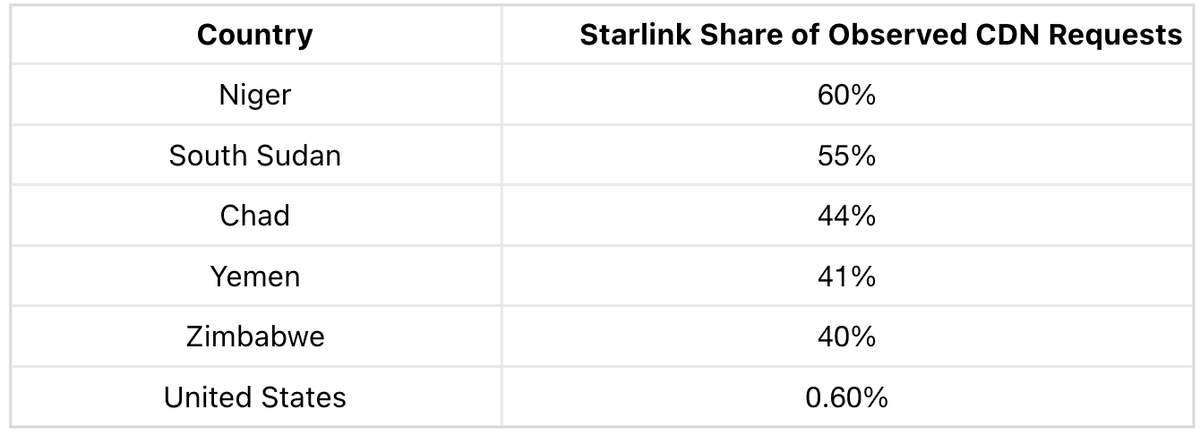
Nevertheless, they reveal how important satellite connectivity has become in markets with limited terrestrial broadband infrastructure.
In many African communities, building extensive fiber networks or mobile towers can be expensive and time-consuming.
Starlink offers an alternative that can be deployed much more quickly, particularly in rural communities, remote businesses, schools, healthcare facilities and industrial sites.
Satellite Internet Adoption Continues to Accelerate
The growth trend is equally notable.
Between February and October 2026, Starlink's share of observed CDN requests increased across several markets:
- South Sudan: from 45% to 55%
- Chad: from 33% to 44%
- Zimbabwe: from 31% to 40%
- Niger: consistently between 55% and 63%
These developments suggest that satellite broadband is becoming an increasingly important component of internet infrastructure in underserved markets.
For local internet service providers, network integrators and Starlink installation companies, this expansion creates new opportunities to deliver reliable connectivity beyond traditional network coverage.
3. IP Allocation Can Signal Starlink's Next Markets
One of the most interesting findings is that IP address allocation can precede official commercial availability.
Between October 31, 2025, and October 31, 2026, Starlink added IP resources for 58 countries and territories that previously had no recorded allocations, bringing the total from 165 to 223.
Vietnam provides a useful example.
Starlink-related IP resources were reportedly allocated as early as April 19, 2026, although significant network activity was not observed until August.
Following an announcement on August 12, daily active IPv4 addresses increased to approximately 150 by October.
Similar developments were observed in Cambodia, Laos, Morocco, Tunisia and the Republic of the Congo.
These markets appeared in Starlink's geolocation data during September 2026, followed by detectable network activity.
Initial daily active IPv4 counts included approximately:
- Morocco: 160
- Republic of the Congo: 110
- Laos: 60
- Tunisia: 40
- Cambodia: 10
Although these numbers remain relatively small, they suggest that network preparation can take place ahead of wider commercial deployment.
Importantly, IP activity does not automatically indicate officially authorized domestic service. Cross-border roaming, maritime connections and aviation terminals may also contribute to the observed traffic.
For satellite internet distributors and installers, tracking these developments can offer an early indication of markets where future demand may emerge.
4. Starlink Is Improving Network Efficiency Through IPv6
As Starlink's subscriber base grows, efficient management of IP resources becomes increasingly important.
The source data reports approximately 13.6 million Starlink subscribers in the third quarter of 2026.
With around 1.04 million allocated IPv4 addresses, this represents roughly 13–14 subscribers per IPv4 address.
This ratio is not a direct measure of simultaneous connections, but it illustrates how modern networking technologies allow large numbers of users to share limited IPv4 resources.
Meanwhile, IPv6 adoption continues to increase.
In February 2026, approximately 51.3% of observed Starlink backbone requests used IPv6. By October, the figure had risen to 56.4%.
This transition helps reduce pressure on scarce IPv4 resources while supporting the continued expansion of Starlink's global network.
5. Starlink Dominates the Satellite Broadband Market
Starlink's expansion is also reflected in its position relative to other satellite operators.
According to the reported October 2026 CDN request dataset, Starlink accounted for approximately 95.8% of observed satellite-network requests.
Other operators represented much smaller shares:Satellite OperatorShare of Observed RequestsStarlink95.8%HughesNet1.9%Viasat1.3%
A separate comparison of Ookla speed-test samples reportedly showed a similar pattern, with Starlink representing approximately 97% of the measured satellite broadband sample.
These measurements should not be interpreted as global revenue or subscriber market share, but they indicate Starlink's substantial presence in the monitored datasets.
Competition is developing, however.
Amazon Leo, formerly known as Project Kuiper, continues expanding its LEO satellite constellation, while established operators such as Viasat and HughesNet remain active across residential, enterprise, aviation and maritime connectivity markets.
The long-term satellite broadband landscape is likely to become more competitive as additional constellations reach commercial scale.
Starlink's growing network presence is more than a telecommunications milestone. It also creates opportunities throughout the satellite connectivity supply chain.
As adoption increases, customers need more than a satellite terminal.
Reliable installations often require suitable mounting hardware, extension cables, power systems, networking equipment and weather-resistant accessories.
Three market developments are particularly important.
Growing demand for professional installations
As Starlink expands into remote communities and commercial environments, installations become more diverse. Rooftops, industrial facilities, vehicles and outdoor sites all present different mounting and cabling requirements.
Greater opportunities for local resellers and integrators
In markets where traditional broadband infrastructure remains limited, local businesses can build service offerings around equipment supply, installation, maintenance and network integration.
Increasing importance of reliable accessories
As satellite connectivity becomes essential for business operations, installation reliability becomes critical.
High-quality outdoor cables, durable mounting solutions, stable power delivery and properly designed networking equipment can help reduce service interruptions and maintenance requirements.
For distributors and installers, this creates opportunities to move beyond basic equipment sales and offer more complete connectivity solutions.
7. Understanding the Limitations of IP-Based Data
While IP allocation and network traffic provide useful insights, these measurements have limitations.
An allocated IP address does not necessarily represent an active subscriber. Likewise, an active IPv4 address may serve multiple users or devices.
Geographic attribution can also be affected by roaming, maritime connectivity, aviation services and network routing arrangements.
The reported analysis relied partly on Starlink's official geofeed data, which covered approximately 85% of its IPv4 address resources.
Therefore, IP allocation, active-address counts, subscriber estimates and CDN request shares should be treated as distinct indicators rather than interchangeable measures of market penetration.
Conclusion: Satellite Broadband Is Becoming Essential Infrastructure
Starlink's allocation of IP resources across 223 countries and territories illustrates the scale and pace of its global network expansion.
More importantly, traffic patterns show that satellite broadband is already playing a significant role in several underserved markets, particularly in Africa.
Countries such as Niger, South Sudan, Chad and Zimbabwe demonstrate how LEO connectivity can help address gaps left by traditional terrestrial infrastructure.
As regulatory approvals progress, subscriber numbers increase and competition intensifies, the global satellite internet market will continue evolving.
For Starlink resellers, installers and network integrators, these developments highlight a growing opportunity: delivering dependable connectivity solutions to customers who need internet access in increasingly diverse environments.
About Orbitmate
Supports LEO connectivity deployments with practical hardware solutions, including mounting systems, power solutions, and connectivity accessories.