
Executive Summary
As of October 2026, SpaceX has built what this report characterizes as the largest commercial satellite ground infrastructure system in history. More than 100 gateway sites operate in the United States, with over 1,500 gateway antennas deployed domestically. Third-party inventories count more than 150 operating gateway sites worldwide and Starlink points of presence (PoPs) across 56 cities, while Starlink has publicly referred to a global footprint of more than 50 PoPs and service availability in 164 countries and territories.
Starlink’s scale has grown quickly. SpaceX’s connectivity segment, primarily Starlink, reportedly generated US$11.387 billion in revenue and US$4.423 billion in operating profit in 2025. Active subscriptions were estimated at 10.3 million in March 2026, up from about 2.3 million at the end of 2023.
ISLs do not eliminate the need for ground stations; they change their role. A gateway can become a flexible network egress point rather than the only station available to a user’s satellite. Traffic destined for the terrestrial internet still generally needs to enter ground infrastructure and terrestrial networks.
The next challenge is building an integrated space-and-terrestrial network. SpaceX has pursued major spectrum acquisitions and outlined a layered architecture spanning satellites, terrestrial access, and a mobile core. Progress will depend on engineering, regulatory approvals, and relationships with incumbent US mobile operators.
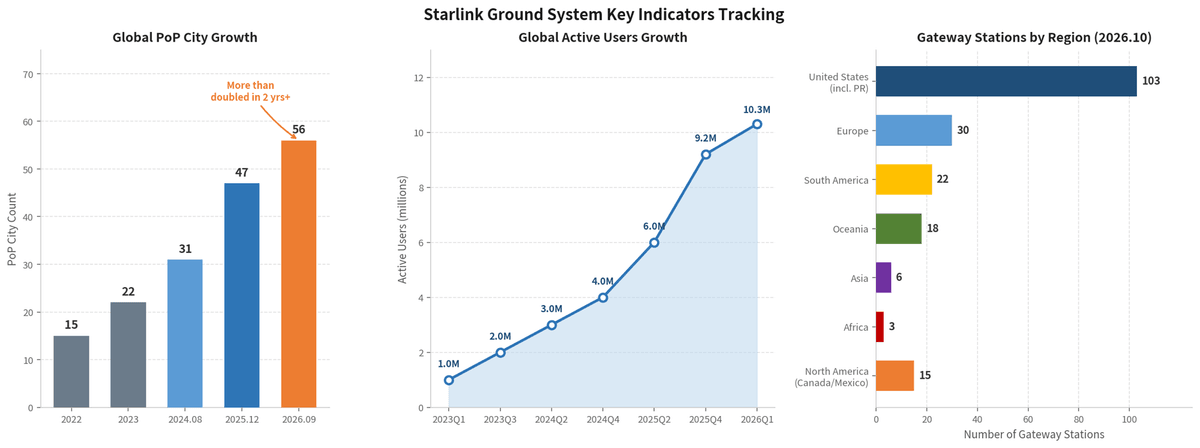
Starlink PoP growth, subscriber growth, and reported gateway distribution
1. Global Deployment of Gateway Stations
1.1 Global Scale and Distribution
Starli
nk’s ground infrastructure combines gateway stations, regional points of presence (PoPs), and user terminals. An October 2025 inventory counted about 150 operating sites, 13 under construction, and 19 planned; expansion continued in 2026.
Gateway-site selection is shaped by four main considerations:
· Proximity to fiber backbones.
· Demand density and expected usage.
· Geographic redundancy to limit single-site failures.
· Spectrum authorization and operating permits.
1.2 United States: A Dense Network of More Than 100 Sites
The United
States is the center of Starlink’s ground infrastructure, with gateway facilities reported across 37 states and Puerto Rico. Texas leads with 11 sites, followed by Washington with eight. Texas’s concentration reflects SpaceX’s wider operational footprint, while Washington is home to Starlink-related manufacturing and operations.
Florida also has multiple sites, while Oklahoma, Georgia, and Idaho reportedly have four sites each and New Mexico and Colorado have two each.
More than 1,500 gateway antennas are reported to operate in the United States, making it the densest part of Starlink’s ground network.
1.3 Deployment by Region
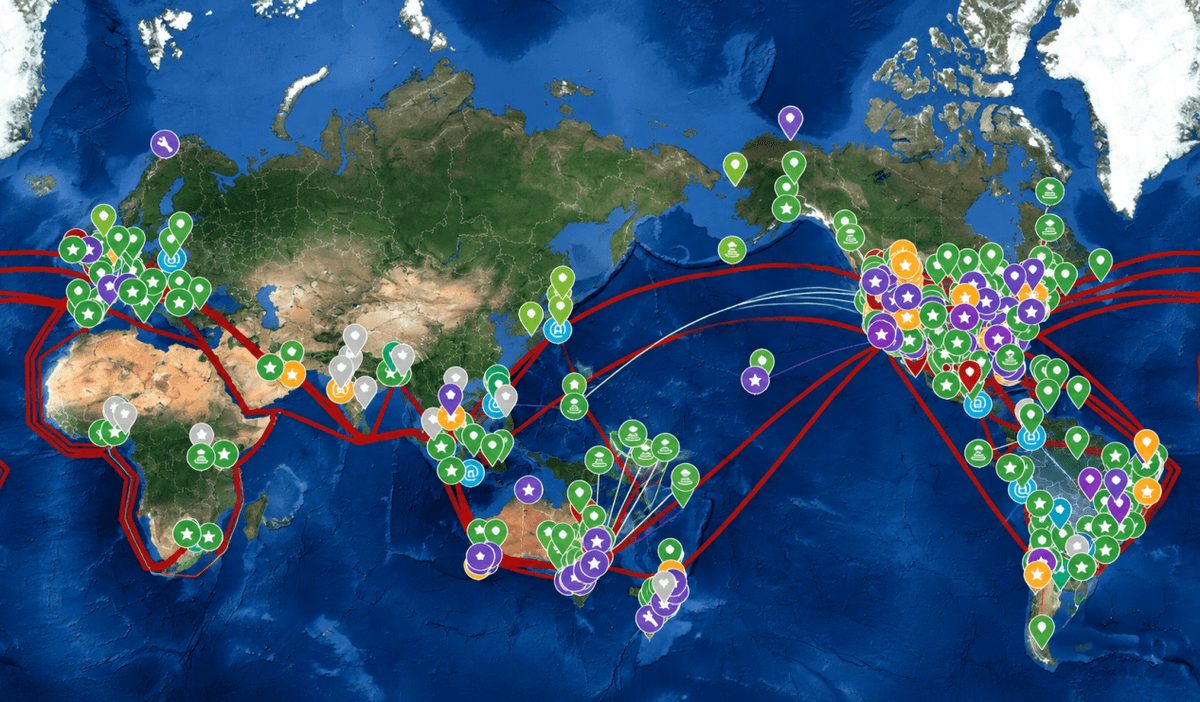
Global Starlink ground-system map
Europe
Europe is described as Starlink’s second-largest ground-infrastructure region. Third-party inventories identify about 30 gateway sites across eight countries, including approved and planned sites. The United Kingdom has eight listed locations, including Goonhilly, historically one of the world’s largest commercial satellite ground stations. Germany, Spain, and Italy have three sites each; Ireland has two; and Norway, Poland, and Lithuania have one each.
South America
Brazil is South America’s principal market and is described as Starlink’s largest overseas country market. Third-party counts list 14 Brazilian gateway sites and seven in Chile. Argentina has three, while Peru, Colombia, and Ecuador each have one. In 2025, Starlink reportedly deployed a Community Gateway in the Galápagos Islands.
Oceania and Asia
Australia is the
main hub in Oceania, with 16 reported sites across cities including Canberra, Perth, and Sydney. New Zealand and Singapore are each listed with one gateway. Asia’s footprint is comparatively sparse: Japan has four reported sites, the Philippines has one in Pasig, and Malaysia and the United Arab Emirates are each listed with one.
MEASAT has been Starlink’s officially authorized distributor in Malaysia since 2024, according to the source report. The report also states that, as of October 2026, SpaceX had not officially announced a new large gateway station in Penang. This should be read as the status recorded in the source, rather than as an independently verified current statement.
Africa
Lagos in Nigeria, Nairobi in Kenya, and Johannesburg in South Africa are identified as major PoP hubs supporting lower-latency connectivity across Africa. The source report states that public information confirmed a Starlink gateway deployment in Nigeria, while the other locations are discussed primarily in terms of PoP and interconnection infrastructure.
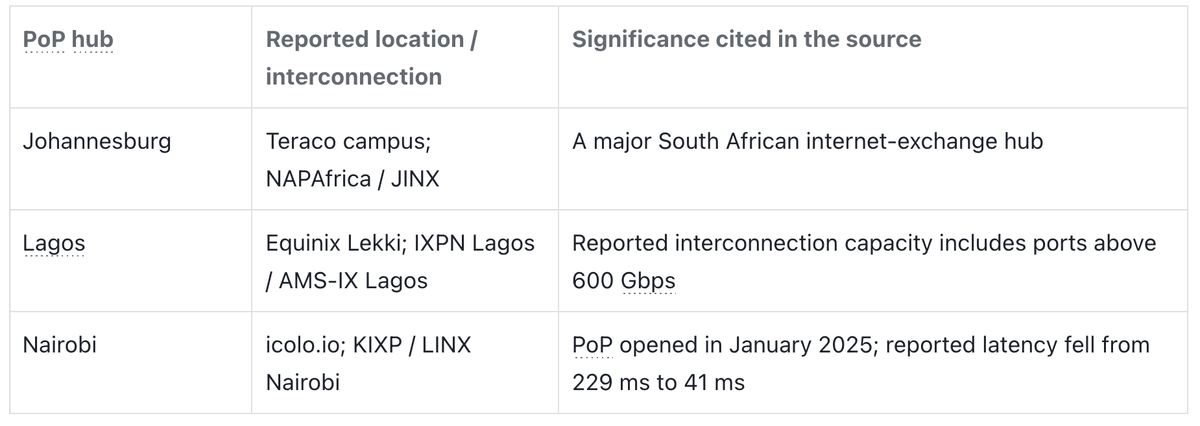
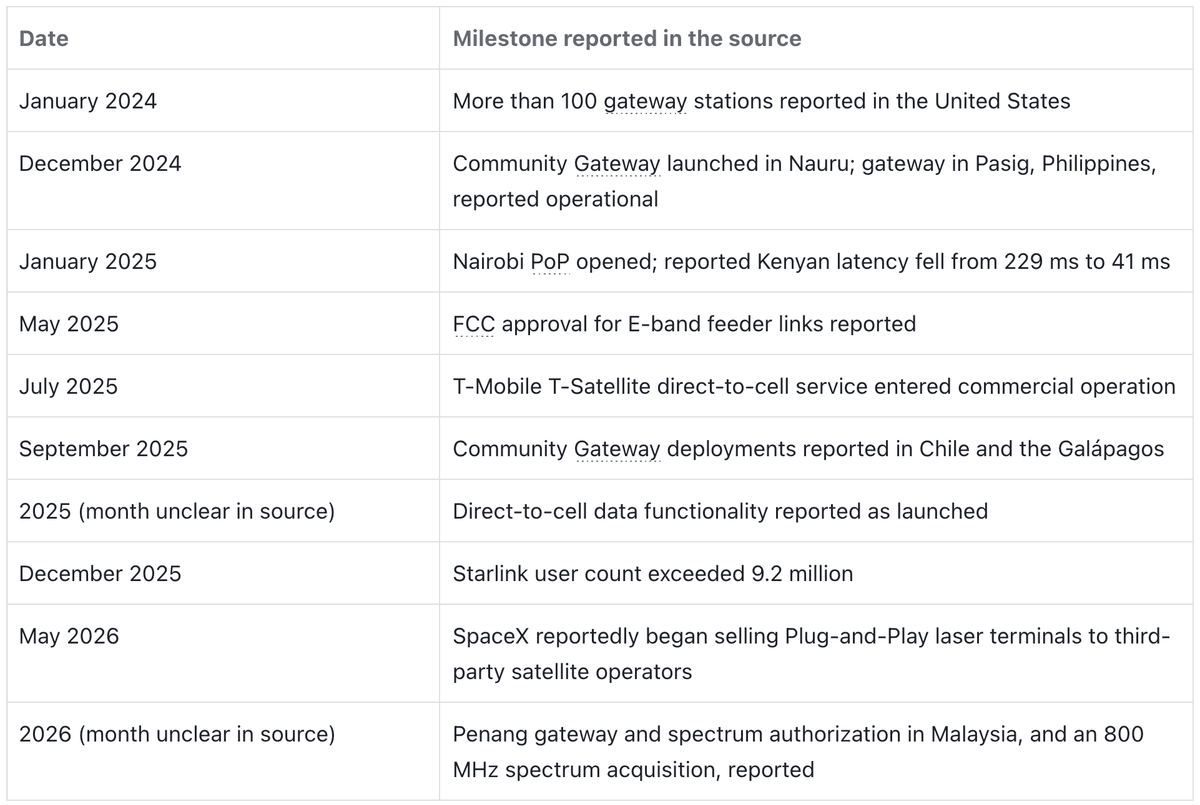
The Nairobi PoP is a milestone in regional localization. Before August 2024, roughly two-thirds of African Starlink traffic reportedly transited through Europe, and Kenyan latency averaged about 229 ms. After the local PoP launch, reported latency fell to about 41 ms.
1.4 Gateway Technology and Radio Parameters
Starlink’s gateway configuration
varies according to the link being served:
- User links: Ku- and Ka-band spectrum is used for communication between satellites and user terminals. The source gives ranges of 10.7–14.5 GHz for Ku band and 26.5–40 GHz for Ka band.
- Feeder links: Earlier gateway feeder links relied primarily on Ka band. The report says V3 satellites are designed to support aggregated Ka-, E-, V-, and W-band RF feeder links, with a total per-satellite feeder capacity of up to 1.2 Tbps.
- E-band: The report lists 71–76 GHz for Earth-to-space uplink and 81–86 GHz for space-to-Earth downlink. It states that SpaceX filed an application with the US Federal Communications Commission (FCC) in November 2025 for E-band gateway-station operations.
- Antenna systems: Gateway sites use multiple parabolic antennas, with large sites potentially hosting dozens. Earlier Ka-band gateway antennas are described as approximately 1.4 metres in diameter, while newer four-band antennas are listed at 1.99 metres. The United States is reported to have more than 1,500 gateway antennas in total.
2. Ground Network Architecture and Technical Implementation
2.1 Integrated Space-to-Ground Network
Topology
Starlink primarily uses a bent-pipe ar
chitecture, with inter-satellite links (ISLs) adding a relay layer. The end-to-end path has three main stages, supplemented by in-space routing.
Stage 1 — User link. A phased-array terminal connects to a visible satellite over Ku/Ka bands. The source cites OFDM/QAM modulation, about 48 spot beams per satellite, a beam diameter of roughly 60 km, and approximately 96 Gbps downlink capacity for V2 Mini.
Stage 2 — Feeder link. Earlier systems primarily used Ka band to connect satellites to gateways. The source says V3 will aggregate four bands for up to 1.2 Tbps of feeder capacity, linking satellites to terrestrial fiber.
Stage 3 — Terrestrial backbone. Traffic travels over fiber from a gateway to a PoP and reaches the wider internet through IXPs and peering.
ISLs add another routing layer. The source reports that 7,000+ V2-series satellites carry three laser links each at 100–200 Gbps per link; V3 is described as having six 400-Gbps links (2.4 Tbps aggregate). ISLs can route traffic around congested or unavailable gateways.
2.2 Routing Protocols and Network Design
Starlink operates autonomous system AS14593 and uses Border Gateway Protocol (BGP) to peer with other networks at more than 30 IXPs worldwide. The source describes its policy as open peering, with settlement-free peering preferred.
Traceroute-based academic studies cited in the source suggest that much Starlink traffic has used a single-hop bent-pipe path: a packet travels from a user terminal to a visible satellite, down to a nearby gateway, and then into terrestrial fiber networks. In other words, traffic does not necessarily traverse multiple satellites through laser links simply because the constellation has ISLs.
That does not make ISLs unimportant. Their value lies partly in routing flexibility. If a gateway is congested or unavailable, traffic may be relayed through space to another gateway. The source also notes that ground-control infrastructure can precompute routing tables and upload them to satellites, taking advantage of the predictable nature of orbital motion.
2.3 PoP Expansion and ISP Peering
PeeringDB figures cited in the source indicate rapid growth in Starlink’s network presence. Between August 2024 and September 2026, the number of listed facilities reportedly increased from 31 to 65, while network centers rose from 42 to 78. The number of PoP cities grew from 31 to 56, and the proportion of users located within 1,000 km of a PoP increased from 79% to 88%. The report cites an industry estimate that each additional 1,000 km of distance from a PoP can add approximately 25 ms of latency.
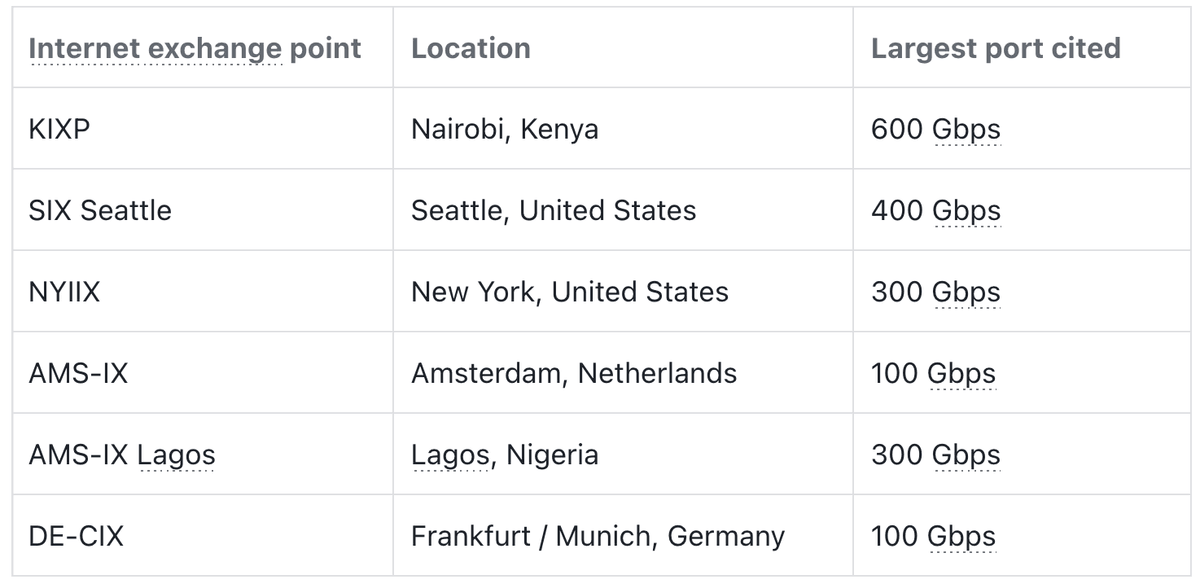
Starlink also reportedly peers with Google Cloud and CDN providers such as Fastly and Cloudflare, potentially shortening the path to popular online services.
2.4 CDN and Content Delivery
SpaceX has not publicly disclosed its CDN deployment details. However, traceroute observations and peering records suggest that major CDN providers have a presence within or near key Starlink PoPs. Local caching could shorten the path for popular video and social-media content, although the precise topology remains unconfirmed.
3. Global Deployment Strategy and Commercial Analysis
3.1 Market Access and Local Partnerships
Starlink’s service footprint
spans a large number of countries, but market entry has not been uniform. The source says Starlink had entered 155 countries at the time referenced, while its executive summary cites service coverage in 164 countries and territories. These figures may reflect different dates or definitions. India’s authorization process has faced delays related to national-security review and local data requirements. China and Russia are described as markets where sovereignty and regulatory barriers prevent commercial operation. In many other countries, access depends on spectrum coordination and operating licenses.
Malaysia is presented in the source as an example of a dual-track market-entry strategy combining local infrastructure investment with local partnerships. It states that, in October 2026, the Malaysian Communications and Multimedia Commission (MCMC) confirmed Starlink spectrum authorization, and that SpaceX announced plans for a large gateway in Penang alongside cooperation with local operator MEASAT. These claims are reproduced from the supplied report and have not been independently verified here.
Africa illustrates the shift from international backhaul to regional localization. Before 2024, much Starlink traffic from Africa reportedly transited through European PoPs, increasing latency and potentially raising transport costs. Local PoPs and gateway infrastructure associated with Nigeria, Kenya, and South Africa in 2025 are described as improving latency and generating additional traffic for exchanges such as IXPN Lagos, KIXP, and LINX Nairobi.
3.2 Investment and Revenue
The source attributes the following financial and subscriber figures to SpaceX’s overall performance and its connectivity segment, primarily Starlink:
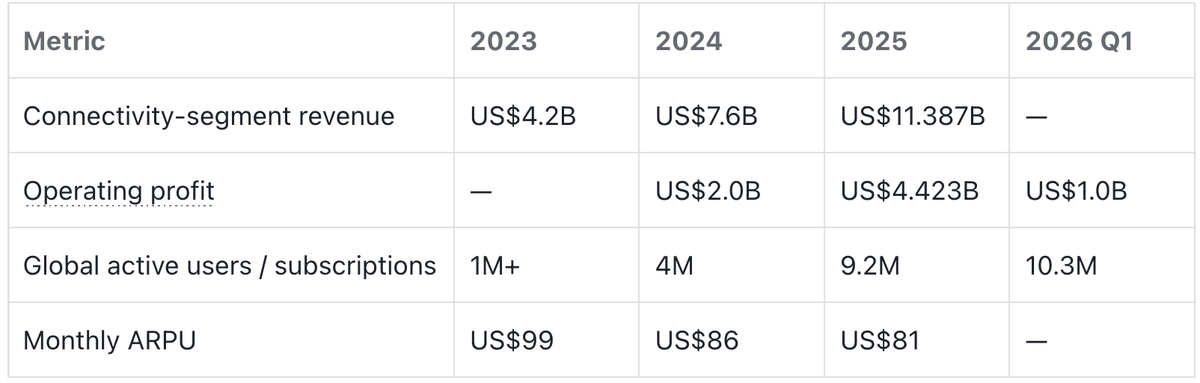
The connectivity segment reportedly accounted for 61% of SpaceX revenue. Its operating margin rose from about 26% in 2024 to 38.8% in 2025, attributed in the source to scale and lower terminal costs.
SpaceX has not disclosed a complete ground-system investment figure. The source points to more than 100 US sites, over 150 global sites, equipment and operating costs, and major spectrum transactions as indicators of the scale involved. These are estimates, not a disclosed infrastructure budget.
3.3 Spectrum Strategy: A Reported US$28 Billion Portfolio
The source describes an EchoStar AWS/H-Block deal valued at about US$20 billion, plus a commitment to fund roughly US$2 billion in debt interest through November 2027, and a proposed US$8 billion acquisition of nationwide 800 MHz spectrum from Grain Management. The latter was reportedly awaiting FCC approval in October 2026. Combined value is about US$28 billion, with some estimates at US$27.6 billion.
If completed as described, the acquisitions would give SpaceX low-band spectrum with stronger propagation characteristics, alongside AWS and H-Block mid-band spectrum, including frequencies around 2 GHz. The source presents these holdings as supporting Starlink Mobile and direct-to-cell services.
For comparison, the report estimates SpaceX’s nationwide licensed mobile spectrum bandwidth at approximately 79 MHz, compared with roughly 780 MHz combined for AT&T, Verizon, and T-Mobile. It estimates that each incumbent holds about 280–380 MHz. The report identifies the claimed technology-neutral nature of the relevant FCC authorizations as strategically important because it could support both satellite-to-phone connectivity and terrestrial cellular infrastructure, subject to applicable approvals and conditions.
3.4 Ground Infrastructure: Competitive Comparison
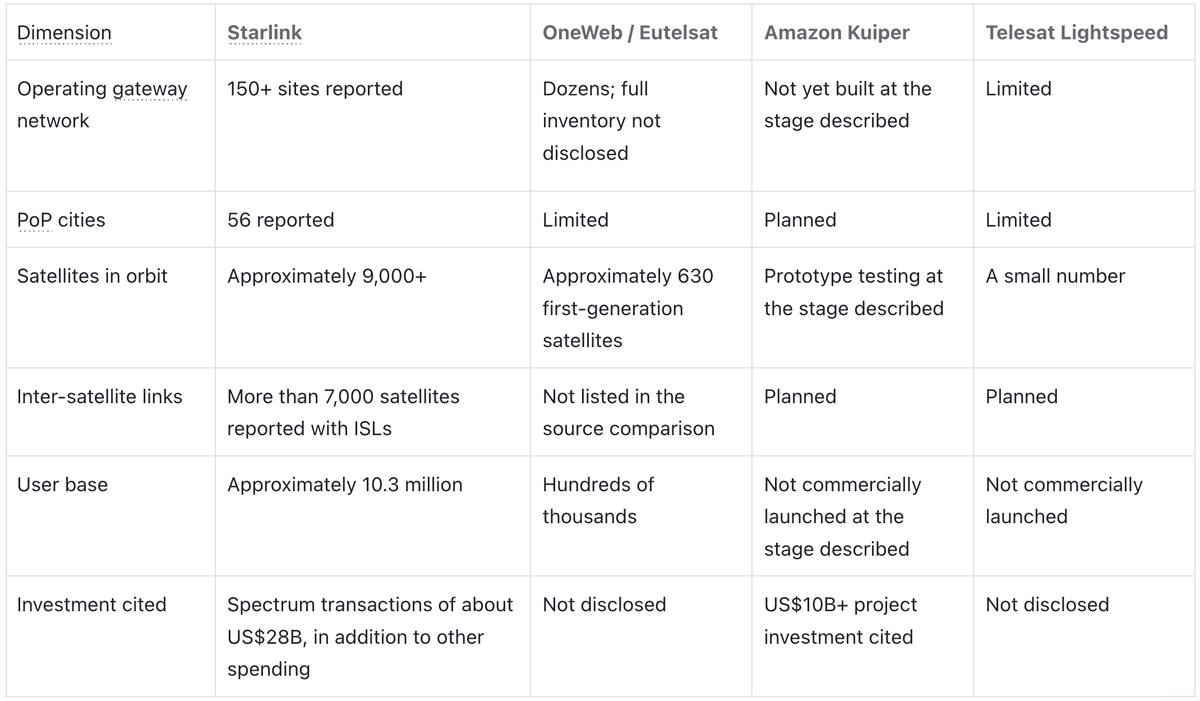
The source concludes that Starlink’s reported gateway footprint and geographic reach exceed those of the listed competitors. OneWeb/Eutelsat operates at a smaller scale, while Amazon Kuiper’s ground system was still at an early stage during the period covered. Competitive positions should be reassessed as new disclosures emerge.
3.5 Government and Military Applications: Starshield
Starshield is described as a government-oriented derivative of Starlink with a distinct operating model. The source states that the system is owned and controlled by the US government rather than being a conventional SpaceX commercial asset, and that network scheduling, bandwidth allocation, and data processing prioritize US national-security and military requirements.
Capabilities described include encrypted communications, battlefield awareness, high-precision positioning, and support for remote-sensing and military payloads. Starshield reportedly shares some technology with commercial Starlink, while encrypted links and payload processing are separate; ground-station details are classified. The source says speed restrictions were determined by the US military and the president.
4. Recent Developments and Future Outlook
4.1 Key Milestones, 2024–2026
4.2 How Direct-to-Cell Affects Ground Infrastructure
Direct-to-Cell (DTC) changes the demands placed on Starlink’s ground network. The source describes more than 650 V1 Mobile satellites operating in low Earth orbit at altitudes of approximately 350–550 km. Equipped with phased-array antennas and using T-Mobile PCS spectrum at 1910–1995 MHz, these satellites can connect to ordinary mobile phones using standard LTE protocols, effectively acting as cellular base stations in space.
Each satellite may handle thousands of phone connections, but traffic still needs to reach the terrestrial mobile core. DTC therefore increases gateway backhaul and traffic-management requirements, even though the satellite itself acts as the access base station.
4.3 A Three-Layer Hybrid Space–Terrestrial Network
In August 2026, according to the source, SpaceX disclosed a three-layer architecture for Starlink Mobile, suggesting a strategic move beyond filling coverage gaps toward building a more integrated mobile network.
- Space layer: Second-generation direct-to-phone satellites would act as 5G base stations. The source describes a phased-array antenna area five times larger than before and 2,048 beams covering the ground.
- Terrestrial access layer: The report proposes using Starlink user terminals as part of a distributed access network. It describes the possibility of integrating small 5G microcells with Dishy terminals and connecting them to terrestrial fiber, with a target of hundreds of thousands of distributed access nodes.
- Core-network layer: Traffic would be backhauled through Ku/Ka radio links or laser links to ground stations and then into a 5G core network. The source says SpaceX intends to use its 800 MHz spectrum resources as part of a hybrid network.
The source says AT&T, Verizon, and T-Mobile rejected MVNO access for Starlink and were considering a joint venture. SpaceX is pursuing 3GPP’s NR-NTN framework while investing in spectrum and infrastructure to reduce dependence on incumbent operators. The proposed use of user terminals as distributed access nodes remains forward-looking unless confirmed by further disclosures.
4.4 How ISLs Change Dependence on Ground Stations
ISLs loosen the link between a user’s location and the nearest gateway. Rather than relying on a single nearby gateway path, traffic can be relayed through space to another site hundreds of kilometres away.
- Reduced dependence on any single site: if a gateway fails or becomes congested, the constellation may redirect traffic to another available site.
- Improved utilization: capacity can be concentrated in locations with better fiber connectivity and lower operating costs, rather than requiring every gateway to handle traffic in the same way.
ISLs do not remove the need for ground stations. Satellites still require ground infrastructure for telemetry, tracking and control, command uploads, software updates, and time synchronization. Traffic intended for terrestrial internet services must ultimately be handed off to ground networks. The source cites a September 2026 fire at a Polish ground station as an example of the value of redundancy: neighboring sites reportedly took over service for Central European users without an interruption.
4.5 New Ground-System Requirements for V3 Satellites
V3 satellites, which the source says were planned to begin deployment around mid-2027, would increase the performance requirements for gateway infrastructure.
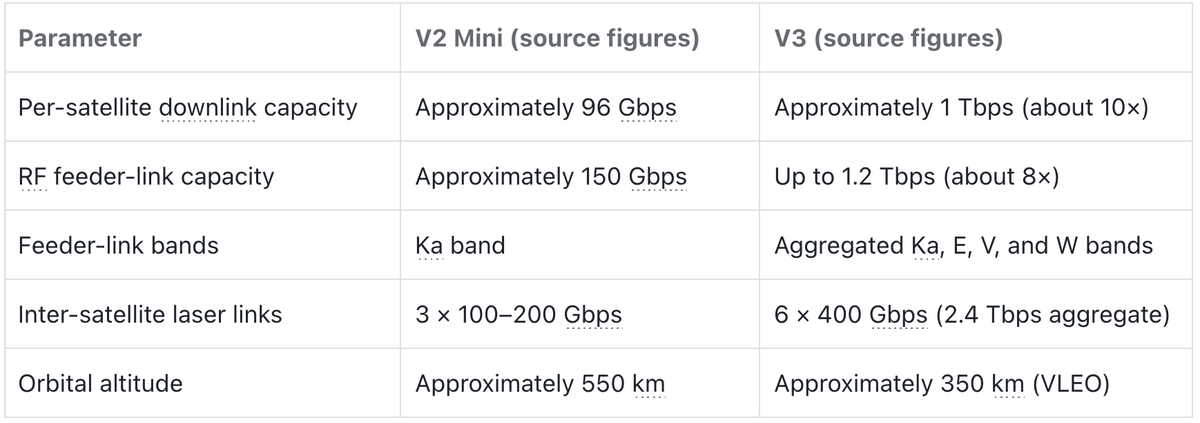
At a stated 1 Tbps downlink capacity, a V3 satellite could approach the throughput of a small gateway site, making multi-band, high-capacity feeder links essential. An orbit near 350 km could reduce propagation loss by about 4 dB and permit smaller user antennas, but would require faster satellite tracking.
The proposed V3 orbit at around 350 km would reduce propagation loss by approximately 4 dB, potentially allowing smaller user-terminal antennas. At the same time, the faster apparent movement of satellites across the sky would place greater demands on gateway tracking systems.
4.6 Longer-Term Possibility: Space-Based Data Centers
The source reports that SpaceX sought FCC permission in December 2025 to launch up to one million satellites, some potentially equipped with optical payloads for orbital data centers. If partly realized, ground infrastructure could become a high-capacity backhaul layer for space-based computing. The concept faces major spectrum, orbital-debris, and regulatory constraints and remains a long-term scenario.
Such a model could require a new class of ground station with much higher-capacity reception and direct connectivity to terrestrial data centers. However, the proposal faces substantial constraints, including spectrum availability, orbital-debris risks, and international regulation. It remains a long-term scenario rather than an established deployment plan.
5. Conclusions and Strategic Implications
Starlink has a substantial reported lead in commercial satellite ground infrastructure: 150+ gateway sites, PoPs in 56 cities, and about 10.3 million active subscriptions.
The ground system is evolvi
ng from a simple satellite-to-internet access path into a flexible set of nodes within a broader space-and-ground network. Community Gateways, direct-to-cell services, hybrid mobile networking, and possible space-based data centers could reshape how traffic is routed and processed.
Four strategic takeaways
- Ground stations are evolving from fixed landing points into flexible network nodes. ISLs can improve routing options and resilience, but they do not eliminate the need for terrestrial egress, control, and backhaul.
- Spectrum is a strategic layer of infrastructure. The spectrum acquisitions described in the source are not simply an effort to obtain additional access capacity; they are also intended to support a more integrated satellite-and-terrestrial network.
- Government and commercial systems are converging technologically, but not necessarily operationally. Starshield illustrates how commercial satellite technologies can be adapted for government and military use while maintaining separate control and security arrangements.
- Starlink’s infrastructure lead raises the bar for competitors. The combination of gateway density, PoP expansion, ISLs, and a large subscriber base creates a scale advantage that newer systems such as Amazon Kuiper and other LEO constellations would need time and investment to match.
Overall, Starlink’s ground infrastructure should be understood as a strategic network asset, not simply a collection of satellite dishes. Its future competitiveness will depend on continued gateway upgrades, regional interconnection, spectrum access, redundancy, and successful integration with terrestrial networks. The quantitative claims and forward-looking scenarios in this report should be revisited as official filings, regulatory decisions, and deployment data become available.
About Orbitmate
Supports LEO connectivity deployments with practical hardware solutions, including mounting systems, power solutions, and connectivity accessories.